The joy of hitting the high notes with ANZA Singing

Maybe you warble in the shower. Perhaps you’ve been known to steal the spotlight at Singapore’s Candy K-Bar Family Karaoke. Or maybe you go full John Farnham once a year at the ANZA Ball. However it happens, when you sing, something shifts. Shoulders drop. A smile lingers. You feel lighter, happier, more connected – and there’s a science behind it.
Singing is more than just fun and an opportunity to let rip – it’s seriously good for your health. Studies show that singing can boost immunity, improve posture and blood pressure, and reduce chronic pain. GP’s in the UK are now prescribing singing for mental health and other chronic conditions, with impressive results.
“Singing triggers the release of endorphins, serotonin, oxytocin, and dopamine – all the ‘feel-good’ chemicals in our body,” explains Dr. Hina Kadwani, General Practitioner at Singapore’s International Medical Clinic (imc-healthcare.com). “It promotes deep breathing, lowers cortisol (our stress hormone), and even improves cardiovascular health. It really is a full-body workout for both your brain and emotions.” This may be music to the ears of ANZA Singing – just one of our community’s many interest groups. but most of this growing gaggle of enthusiastic vocalists who meet weekly to connect, harmonise, and raise their voices together, are already privy to this positive info.

“I knew I needed to sing and make singing friends for my mental health,” explains Kimberley Booth, who leads ANZA Singing and has been a trusty participant for over two years. “After having kids, I found that singing was the one thing that I did just for me. When I discovered ANZA had a singing group after moving to the Lion City as an expat, it was the perfect fit.”
Kimberley, who has a background in choral leadership and performance, and sang with the Australian Military Wives Choir, knows firsthand the emotional power of group singing. “I’ve seen so many members of our group go from saying they ‘can’t sing’ to performing on stage with huge smiles and beautiful pitch,” she says. “Singing helps us to let go, be vulnerable, and connect. It’s like a shortcut to belonging.”
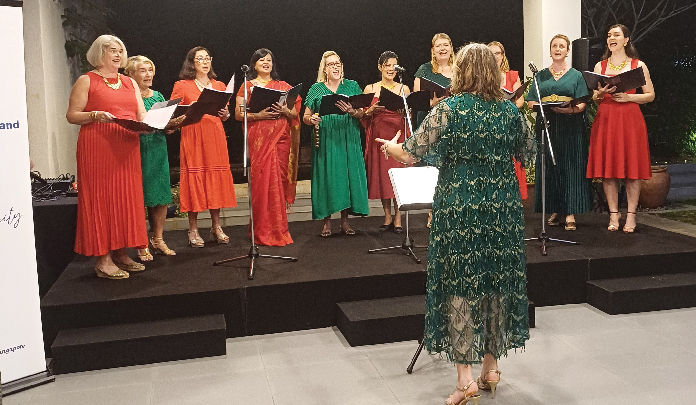
ANZA Singing at Christmas in the Garden 2024
Cathartic & primal
Group singing, Dr. Hina agrees, can work to foster social connection and combat loneliness. “Crucially, it increases oxytocin, which supports trust and bonding,” she says. “It offers an emotional outlet and reduces isolation, not to mention the opportunity to attend regular sessions gives people a comforting structure, which is especially helpful during times of stress or grief.”
One study showed that group singing can boost immune markers after just one hour, while another found that singing increased naturally occurring endocannabinoids in the body – chemicals linked to mood, pain relief, and relaxation. For Kimberley, ANZA Singing has become more than just a hobby – it’s a lifeline. “The singers in the group are my friends and kindred spirits who lift me up, check in on me, and connect me to new adventures,” she says. “We don’t just sing together, we travel through life’s journey together, too.”
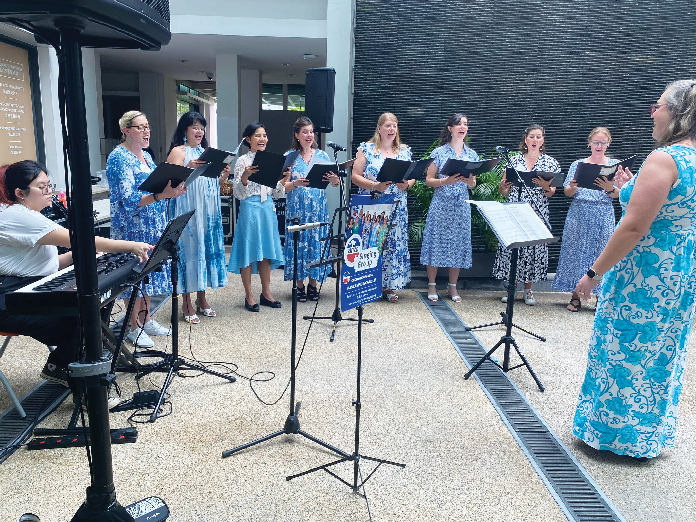
Kimberley conducting in 2024
And it’s not only the heart that benefits. Singing is proven to boost memory, attention and cognitive function. “It acts like brain training,” confirms Dr. Hina. “You’re engaging several parts of your brain at once, and this is particularly valuable in childhood and as we age.” Singing familiar songs can also support people living with dementia. This is because it enhances posture, breath control and lung function, which is particularly useful for those recovering from respiratory illnesses or managing conditions like asthma. “It’s also been used in Long Covid rehab, and some studies show it can help alleviate chronic pain,” says Dr. Hina, who recommends that singing becomes part of public health. “Encouraging it in schools, communities, and care settings could improve population wellbeing and should be employed as a form of therapy.”
Thankfully, at ANZA Singing, the focus is not on lung capacity or brain chemistry. This jolly group simply love the magic of making music together. “We use our whole body, our mind, our heart, and often our sense of humour to get a tune out!” laughs Kimberley. “It’s cathartic and primal in so many ways. I’ve laughed and cried through songs. Singing allows you to feel, and to be felt.”

From left: Aditi, Brigitte, Nikki, Kimberley, and Rachel
While this all sounds wonderful in theory, not all of us have the confidence to let rip with an 80’s power ballad out of the confines of our own home. So what would Kimberley say to someone who insists they are too shy to go for it in public? “Come along and try! Maybe you can’t sing yet, but I believe everyone can learn. We’ll teach you at your pace and have loads of fun in the process.”
Whether you’re in it for the wellness wins, the feel-good company, or to indulge your inner Beyoncé, singing really does have something for everyone. And it could be one of the most powerful, joyful – and highly affordable – tools we have to boost connection and wellbeing. As Kimberley puts it,“When words fail, music speaks.”
Sources: Studies and subsequent research by Dr Daisy Fancourt from University College London (UCL); studies by Kreutz, Journal of Behavioural Medicine
Discover more about ANZA Singing and how to get involved.