Uncover Singapore’s stunning black and whites
They’re grand, confident, and impossibly atmospheric – Singapore’s iconic black-and-white houses remain among the most coveted (and photographed!) properties on the island. “The term ‘black and white’ is actually quite practical,” says Jerome Lim, heritage blogger and founder of The Long and Winding Road. “It refers to the whitewashed walls and black bituminous-painted timbers – finishes that helped reduce heat and ward off termites.”
Originally built for British Government, Municipal and Military Officers, many of these homes borrow architectural elements from Malay kampung houses and plantation estates – think deep verandahs, vented roof tiles, and raised concrete piers that encourage airflow. From stunning Tudor-like gables to surprising French connections and wartime secrets, we stroll through Singapore’s history and heritage through these standout black-and-white properties with Jerome as our trusty guide.
7 Adam Park
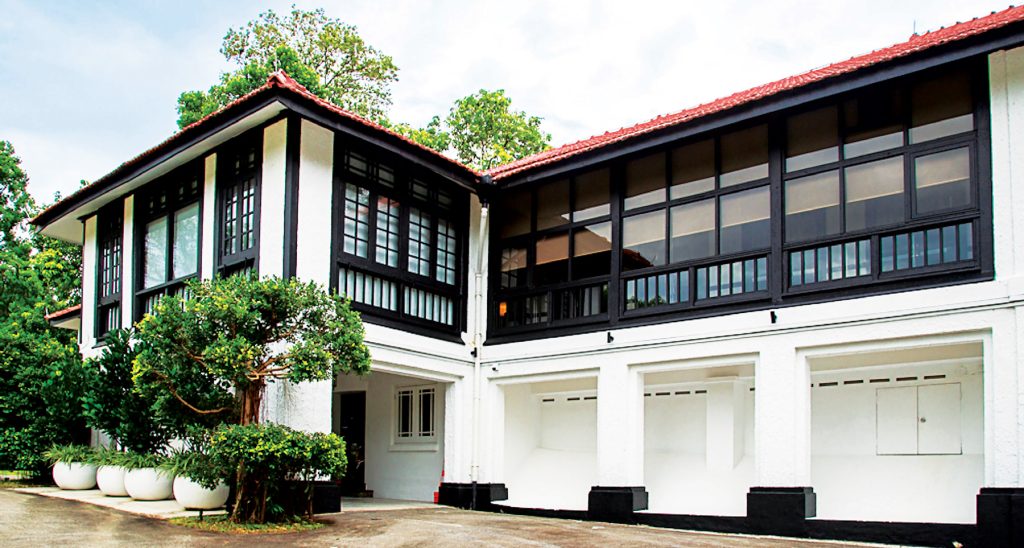
BUILT IN: 1928
BULIT FOR: Junior bachelor officers of the Singapore Improvement Trust. This house later housed Municipal Junior Bachelor Officers before being handed over to the Municipality. One of its well-known residents was K.J. O’Dell, an accountant with the Municipal Water Department, and a gardening enthusiast who transformed the grounds while serving as Honorary Secretary of the Singapore Garden Society.
STANDOUT FEATURES: Positioned on an elevation overlooking Adam Road, this is one of the estate’s most recognisable properties and like many other black-and-whites, its verandahs – once shaded with bamboo blinds – are now enclosed with windows.
Fun fact! During the final days of the Battle for Singapore in 1942, this house served as the field HQ for the 1st Cambridgeshire Battalion. This is thanks to its hidden position away from the Japanese advance. Post-war, it transformed into a clubhouse for NUSS Guild House and later housed Surbana Global Academy. Today, it’s one of 19 Adam Park houses gazetted for conservation and is maintained for non-residential use by Singapore Land Authority (SLA).
7 Adam Park, 289926
Atbara House
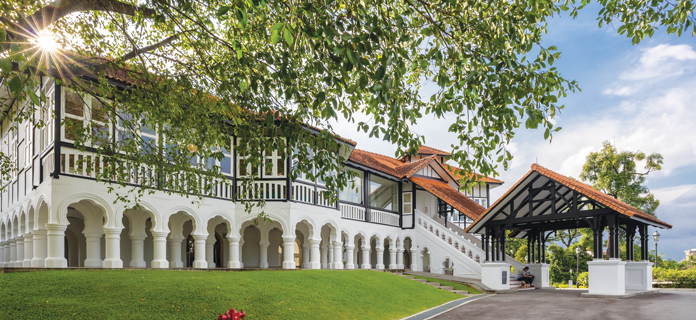
BUILT IN: 1898
BUILT FOR: John Burkinshaw, a lawyer, founder of Donaldson & Burkinshaw, and a Legislative Councillor. Interestingly, Burkinshaw didn’t stay long – newspaper advertisements offering the property “To Let” appeared as early as 1899. By 1903, it was owned by Charles MacArthur, Chairman of the Straits Trading Company, before the company officially acquired it in 1923. From 1939 to 1999, Atbara was leased to the French Foreign Office. The Straits Trading Company retained it until 1990, when it was taken over by the State.
STANDOUT FEATURES: This grand residence boasts seven rooms, five bathrooms, a vast compound, and sweeping views, but what really sets it apart is its striking appearance. The house is elevated on concrete piers adorned with distinctive Moorish-style arches, a signature of architect R.A.J. Bidwell, who also contributed to the Indo-Islamic style seen in Malaysia’s Sultan Abdul Samad Building. Its upper level is rich in timber – perfect for Singapore’s tropical climate.
FUN FACT! Once home to the French Consular Office and later the French Embassy, Atbara was the go-to spot for Singapore residents in need of a French visa. Today, after a meticulous restoration by NParks, it’s now the Forest Discovery Centre at the Gallop Extension of the Singapore Botanic Gardens.
No 5 Gallop Road, 258960
3 & 5 Pender Road
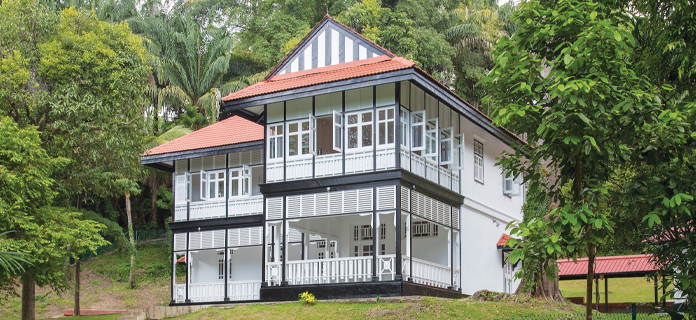
BUILT IN: 1919
BUILT FOR: An electrical engineer with the Eastern Extension Telegraph Company, stationed at the nearby Cable Depot.
STANDOUT FEATURES: These charming homes boast end gables with closely spaced structural beams, giving them a Tudor-esque vibe. Unlike some of their counterparts, they aren’t raised on piers but rest on a solid concrete base. That said, their structure features timber walls, generous verandahs, and a classic layout that remains largely untouched since their original construction. They’re in excellent condition and are currently rented out by SLA.
No 3, No 5 Pender Road, 099168
Houses at Seton Close
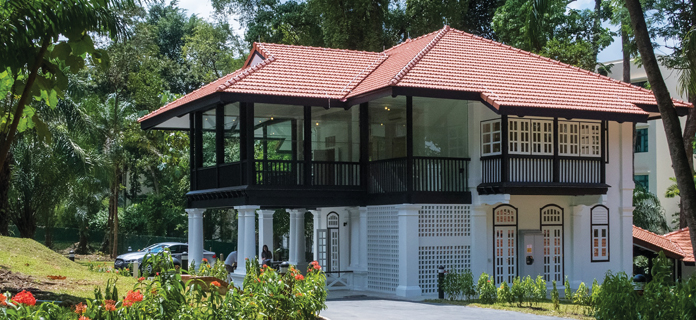
BUILT IN: 1922
BUILT FOR: Senior Government Officers.
Standout features: These stately homes rest on a concrete lower floor, with timber used in the upper levels. They feature whopping verandahs set above a porte-cochère, as well as cantilevered balconies that extend from the sides. Look out for ventilation grilles placed near the main staircases. While the original verandahs were once shaded by bamboo blinds, they’re now enclosed with glass. Today these homes are rented out by SLA.
FUN FACT! One of the notable residents was Carl Alexander Gibson-Hill, the last British director of the National Museum of Singapore (formerly the Raffles Museum), who tragically took his life in the bathtub of one of these homes in 1963.
No 2, 3, 4 & 5 Seton Close, 307987
5 Malcolm Road
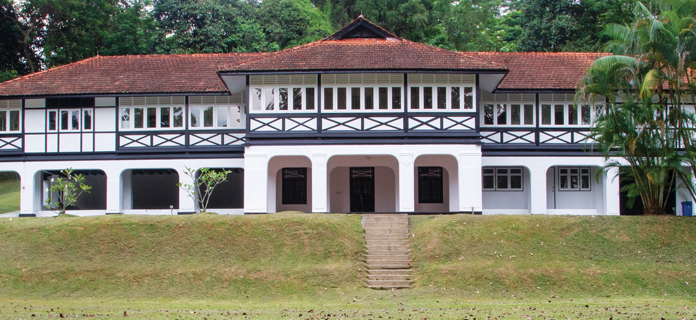
BUILT IN: 1925
BUILT FOR: Senior Government Officers, including the Education and Inspector of Schools.
STANDOUT FEATURES: Designed by H.A. Stallwood and Frank Dorrington Ward of the Public Works Department, this home became the blueprint for colonial government residences across Singapore. Raised on piers and built mainly from concrete, these houses were designed for flexibility – featuring a central portico with a large verandah, a formal entrance hall with the main staircase, and adaptable spaces on the ground floor. The flanking wings housed bedrooms, studies, or offices, and could be extended depending on the seniority of the resident. Simplified versions of this layout are found in neighbourhoods like Alexandra Park, Temenggong Road, and Sembawang. These houses are kept in great shape and leased by SLA.
FUN FACT! The home has hosted high-ranking education officials and, during the Japanese Occupation, was used by a sub-manager of Mitsubishi Corporation.
5 Malcolm Road, 486045
The ‘Japanese’ Theatre & the Jacksons
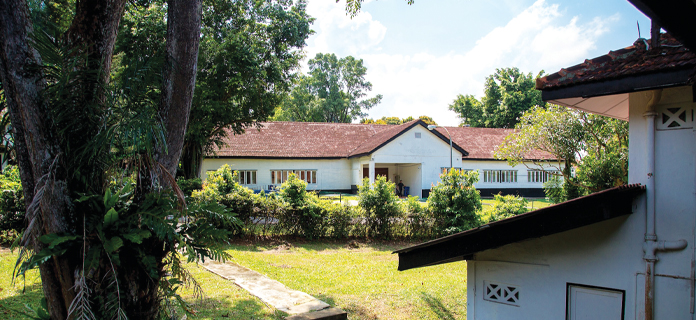
BUILT IN: The Japanese Occupation, 1942 – 1945
BUILT FOR: Use as a community hall and theatre.
STANDOUT FEATURES: This single-storey timber building is quite a contrast to the surrounding “Jackson” houses – named after Sir John Jackson & Co, the Naval Base’s primary contractor who built them to house European employees. Over the years, the theatre has been a hall, theatre, residence, and childcare centre. It sits on the footprint of a war-damaged Jackson house and is currently hoarded up for repairs.
FUN FACT! During WWII, the theatre was reportedly used to screen propaganda films. After the war, it became the ‘Dockyard Theatre’ under the Admiralty, hosting plays, concerts, dances, and even badminton matches.
318-2 Gibraltar Crescent, 759581
If you enjoyed this article on Singapore’s black-and-white houses, explore more stories in our Insider’s Guide section.